

Can You Install a Tent on a Driveway or Patio?
When planning a backyard party, graduation, wedding, or family gathering, you might assume a tent needs to be installed on grass. But what if your backyard is mostly pavement, your patio is the perfect size, or your driveway is the only available space for your event?
The good news is that you can install certain tents on driveways, patios, concrete, and asphalt! The key is choosing the right tent style and determining the best way to secure it based on your property and installation conditions.
At Evo Tents LLC, we provide tent rentals throughout Massachusetts and surrounding areas, with options for a variety of event spaces and installation surfaces. Whether you're hosting a graduation party at home or planning a larger celebration, here's what you need to know about installing a tent on a hard surface.
1. Pole Tents vs. Frame Tents: Which Works on a Driveway or Patio?
The type of tent you choose plays an important role in determining where it can be installed.
Pole Tents
Traditional pole tents use center poles and perimeter poles to support the tent top. They generally rely on stakes driven into the ground to secure the tent properly.
Because of this, pole tents are typically best suited for grassy areas or other locations where staking is possible. They generally aren't the right choice for a driveway or patio where stakes cannot be installed.
Frame Tents
Frame tents use a structural frame to support the tent top without requiring center poles. This creates an open interior and makes them a versatile option for many different event layouts.
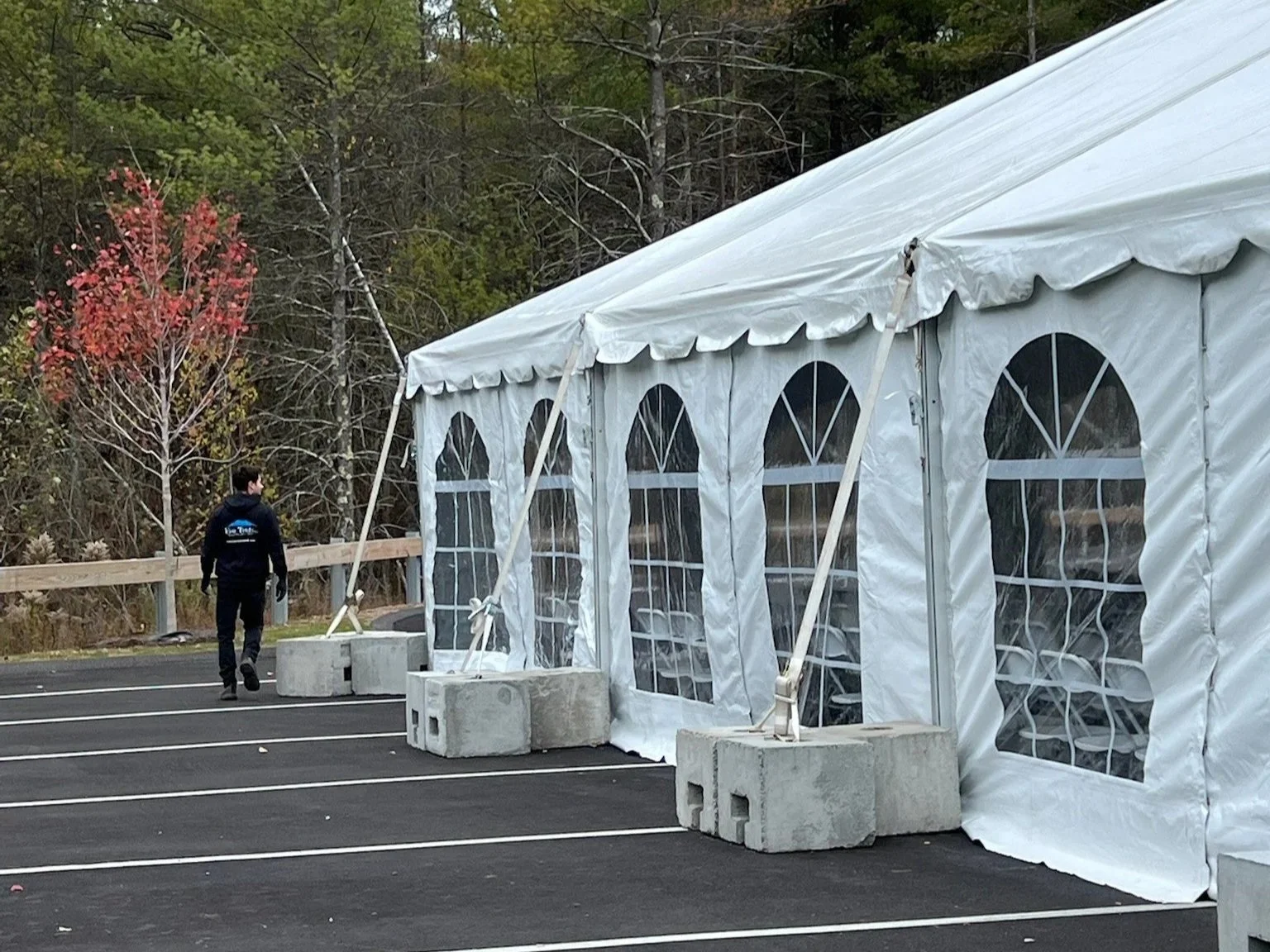
One of their biggest advantages is that frame tents can often be installed on hard surfaces using an appropriate weighting system when staking isn't possible.
This makes them a great option for driveways, patios, parking lots, and other paved areas where you want to create a covered event space.
Evo Tents offers a variety of frame tent styles and sizes to accommodate different events and installation locations. The best option for your property will depend on your available space, guest count, surface, and anchoring requirements.
2. How Are Tents Secured on Concrete and Asphalt?
One of the most common questions homeowners ask is how a tent stays securely in place when it can't be staked into the ground.
On suitable hard surfaces, frame tents can be secured using engineered weights that provide the required anchoring for the particular tent and installation conditions.
However, determining the right amount of weight involves more than simply placing something heavy at each corner.
It's Not Just About the Four Corners
A common misconception is that a tent only needs to be weighed down at its four corners. In reality, many tents have additional perimeter poles and designated anchoring points along their sides that also need to be secured.
The required weight load depends on several factors, including:
Tent size: Larger tents generally require a different anchoring configuration and weight load than smaller tents.
Tent design: Different tent models and structural configurations have different anchoring requirements.
Installation location: The site's exposure to wind and surrounding conditions can affect the anchoring plan.
Anchoring points: Each designated anchoring point must be accounted for when determining the overall setup.
This is why it's important to have an experienced tent installation team evaluate your specific event space rather than estimating the number of weights based on the tent's corners alone.
Can You Reduce the Number of Weights Needed?
Potentially, yes! This is where planning your installation location can make a real difference.
Even if most of your event will take place on a driveway or patio, there may be suitable soft ground surrounding the paved area where the tent can be staked.
When the tent design, layout, and site conditions allow it, staking into appropriate surrounding ground can reduce the number of weights needed. This may also help avoid additional costs associated with supplying and delivering weights.
There may also be situations where weighting a tent instead of staking it is the better option, such as when underground utilities, irrigation systems, or other buried features limit where stakes can safely be installed. Depending on your property's layout, positioning a tent on a hard surface and using an appropriate weighting system may provide a practical alternative.
However, the anchoring method must be appropriate for the entire tent installation. Staking and weighting may sometimes be used together, but the exact configuration must be determined for the specific tent and site.
Photos, measurements, and sometimes a site visit are essential to figuring out where weights will be needed.
When contacting Evo Tents, providing clear photos of the proposed installation area along with its dimensions helps our team understand your property and evaluate potential anchoring options. For more complicated sites, a visit may be necessary to determine the best setup.
Planning this ahead of time helps us identify potential challenges, determine the appropriate anchoring requirements, and explore ways to avoid unnecessary weight and delivery costs whenever possible.
3. Is Your Driveway or Patio Big Enough for a Tent?
Before choosing a tent, measure the available area and consider how the space will be used.
The usable area may be smaller than it first appears once you account for the tent's footprint, anchoring requirements, access points, and the space needed for guests to move comfortably.
When evaluating your driveway or patio, consider:
Available dimensions: Measure the length and width of the proposed installation area.
Clearance around the tent: Allow room for the tent's support structure, required weights, and installation access.
Doors and entrances: Make sure the tent won't block house entrances or emergency access routes.
Obstructions: Look for trees, overhangs, utility lines, light fixtures, and other obstacles.
Guest movement: Plan how people will enter and exit the tent and move between seating, dining, and entertainment areas.
Vehicle access: Determine whether vehicles will need to be moved and whether the tent will interfere with normal driveway use.
Remember that the tent itself is only one part of your layout. If you're planning to include tables, chairs, a buffet, or a dance floor, you'll need enough space for those features as well.
When measuring your space, also consider the surrounding area. A small section of available lawn beside your driveway could provide useful options for staking, potentially reducing the amount of additional weight required.
Evo Tents offers a variety of tent sizes, and our team can help you evaluate your guest count, layout, and available installation space.
4. Can You Put a Tent on a Patio Without Damaging It?
In many cases, a tent can be installed on a suitable patio, but the patio's construction and condition matter.
Concrete patios, asphalt driveways, paver patios, and decorative stone surfaces can all present different installation considerations.
When a tent must be secured using weights, it's important to consider whether the surface can safely support the load without cracking or sustaining damage. Tent weights can be very heavy, and certain decorative or more delicate surfaces may require additional consideration.
Before booking, let your rental provider know what type of surface you have and mention any concerns about its condition.
Depending on the material and installation requirements, it may be necessary to evaluate the surface's ability to support the weight loads and determine whether protective measures or an alternative anchoring arrangement are appropriate.
It's also important to consider drainage, slopes, and the condition of the surrounding area.
Never drill into a patio or driveway, or attempt to attach a tent to your home, railing, or another structure without confirming that the method is suitable and authorized.
Providing photos of the surface can help your rental provider identify potential concerns before installation day.
5. What About Rain and Drainage?
One of the main reasons to rent a tent is to provide covered space for your event. Installing it on a driveway or patio can work well, but rainwater management is an important part of the planning process.
Hard surfaces don't absorb water the way lawns do, so rainfall may flow across the pavement or collect in low areas.
Before selecting your installation location, consider:
Drainage patterns: Identify where water flows during heavy rain.
Low spots: Avoid areas where water tends to pool.
Nearby downspouts: Make sure roof runoff won't drain directly into your event space.
Entry points: Think about how guests will enter the tent without walking through puddles.
Surface slope: Discuss significant slopes or uneven areas with your rental provider.
The tent's design, installation, and site conditions all affect how well the setup performs in wet weather. Sidewalls may help reduce wind-driven rain entering from the sides, but they don't eliminate every weather-related risk.
A tent should also never be considered a guarantee of protection against severe weather. Follow professional guidance if dangerous wind, thunderstorms, or other hazardous conditions are expected.
6. What Events Work Well With a Driveway or Patio Tent?
A hard-surface tent installation can be a great solution when your property doesn't have enough suitable lawn space or when you want to keep your event close to your home.
Some common examples include:
Graduation parties: A driveway tent can provide covered space for tables, chairs, food service, and family gatherings without taking up the entire backyard.
Backyard birthday parties: A patio tent can create a dedicated area for guests to eat, socialize, and celebrate.
Outdoor weddings: Depending on the size and configuration of the space, a frame tent can provide an attractive reception area with room for dining and other event features.
Family reunions and anniversaries: A tent can help create a central gathering space while keeping guests close to the house.
Corporate events: Suitable paved areas can provide space for registration tables, refreshments, seating, or other event functions.
Every property is different, so the best tent style and size will depend on your guest count, layout, surface, and installation requirements.
7. Let Evo Tents Help You Find the Right Tent for Your Space
If your driveway or patio is the best place to host your event, you don't necessarily need to give up on the idea of renting a tent.
The important thing is finding a tent that suits your property and can be installed safely on the available surface.
At Evo Tents LLC, we offer a variety of tent styles and sizes for weddings, graduations, backyard celebrations, and corporate events throughout Massachusetts and surrounding areas.
Our team provides professional delivery, installation, and breakdown, helping you plan your setup from start to finish.
When you contact us, let us know that you're considering a driveway, patio, or other paved surface. If possible, have the following information ready:
Photos of the proposed installation area, including the surrounding lawn or other soft ground.
The approximate length and width of the available space.
Information about the surface material and its condition.
Details about any known underground utilities or other site restrictions.
Your estimated guest count and preferred tent layout.
This information helps us evaluate your property, identify where staking or weighting may be appropriate, and determine whether a site visit would be beneficial.
Planning ahead also gives us a better opportunity to explore options that may reduce the amount of weighting required and avoid unnecessary additional delivery costs.
——————————————————————————————————————————-
Ready to see what's possible in your space?
Visit EvoTentsLLC.com to explore our tent rentals and request a quote. You can also call 508-320-2553 or email Events@EvoTentsLLC.com to discuss your event.
Your driveway or patio might be the perfect place to celebrate. Let's find the right tent and installation plan to make it happen!